TennisOne Lessons
The Slice Backhand CSU Bakersfield Head Coach Dan McCain Even in today’s tennis game, dominated by power tennis and heavy topspin off both wings, the slice or under-spin backhand can still be an effective weapon for any player when executed correctly. The slice backhand can be used in a variety of ways - as an offensive tool, a defensive maneuver, or even as a change of pace and spin that can surprise an opponent.
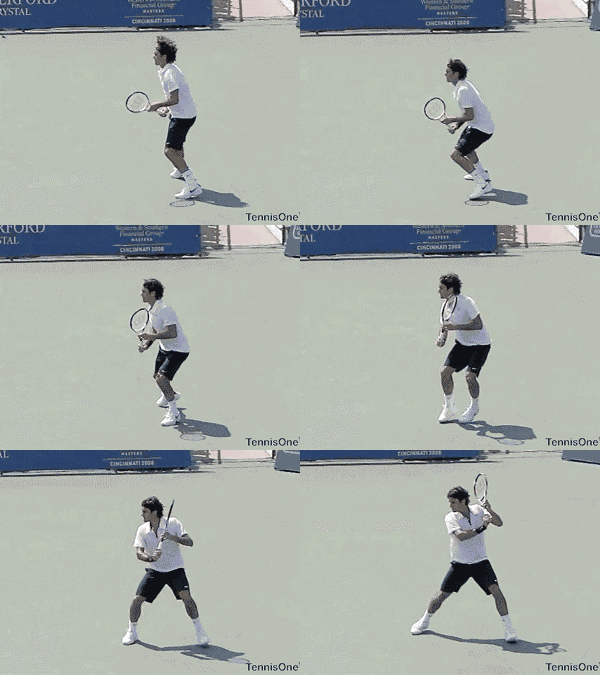
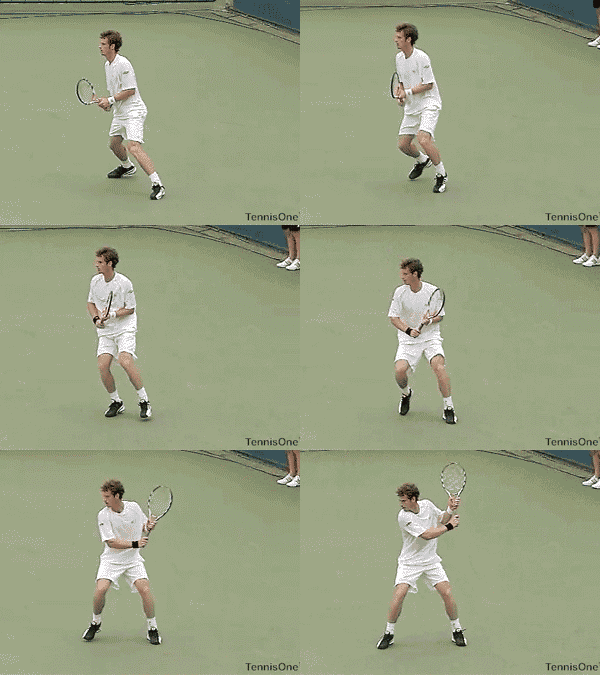
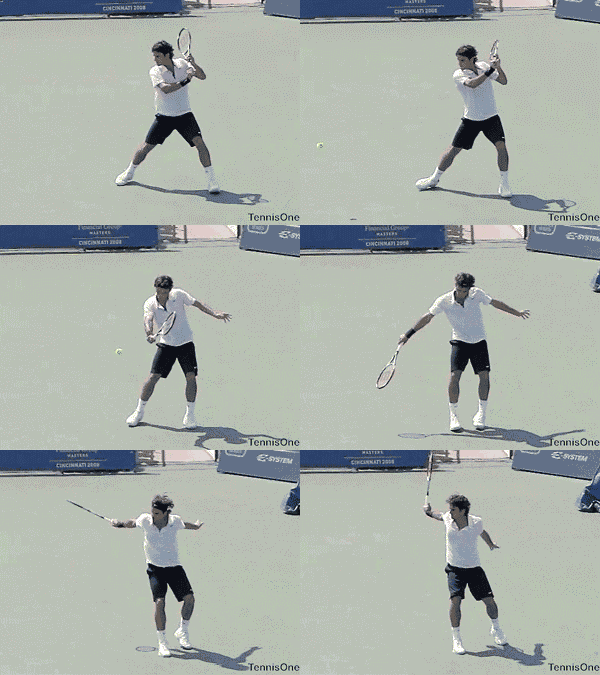
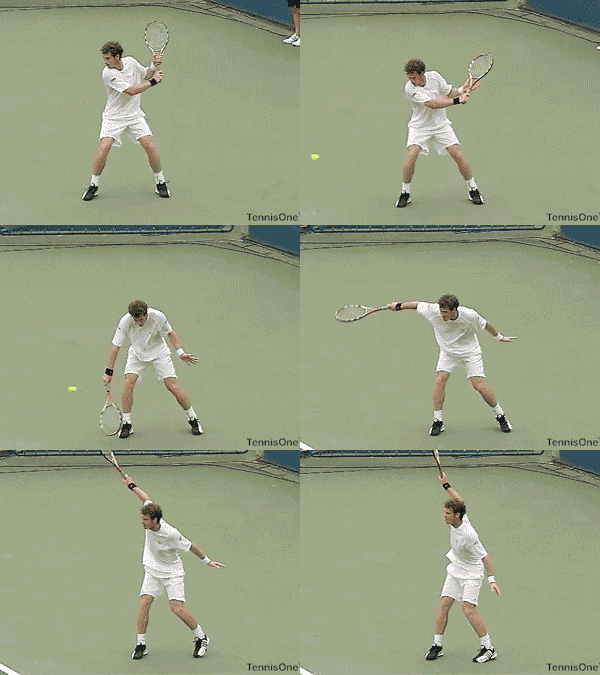
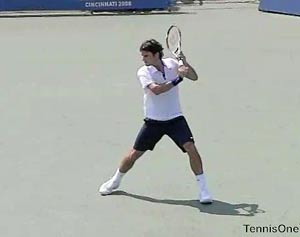
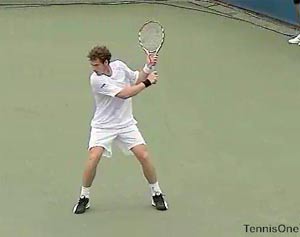
As with any stroke, to execute the slice backhand effectively, a player must first understand two simple concepts, the shoulder and hip turn and the use of the wrist. These elements are the two main ingredients for developing a reliable slice. All of the other elements of technique, while vital to the success of the shot, support these two priorities. Although there are a few players at the pro level who hit a two-handed slice, essentially, the slice is a one-handed stroke. Any and all one-handed backhands require the ball-striker to position the body sideways, with his chest and belly-button facing 90 degrees from the shot target. I often tell my students to show their back shoulder blade to the target. This posture should be established during the preparation for the shot and maintained throughout the entire course of the swing and follow-through. While it can be occasionally permissible for the shoulders to slightly open up - to begin to slightly face more towards the net, it is paramount to keep the hips closed or sideways throughout the entire stroke. Executing this idea can be challenging for players with two-handed backhands who are accustomed (or should be) to opening up their shoulders and hips upon impacting the ball. Not opening up is often a difficult habit to create for them, but one that needs to be developed over time. The positioning of the wrist throughout the slice is equally as essential as learning how to turn (or not turn, depending on how you look at it). I use the terminology “set the wrist,” “lock the wrist,” or establish a “U-shape” with the wrist. They all mean the same thing - take an eastern grip and lift up the wrist to where you can literally see a shape that looks like the letter U created by the back of your palm, your wrist and the top of your forearm. By laying your wrist back in this way, you put yourself in a position of strength when contacting the ball. There’s no question that Roger Federer has the best slice backhand in the game today. But Andy Murray has a great slice too and both players have a great deal in common with their technique. Both players set their wrist as they take their racquets back during preparation and they keep their wrists set and in a locked position throughout the stroke. Their wrists are set so much during the backswing that as they wrap their racquets behind their necks, their strings (particularly Federer's) almost touch their hair. The backs of their hands face their left ears.
Both Federer and Murray keep their wrists locked throughout the stroke so much so that both players use a substantial follow-through to give themselves added insurance to help maintain the wrist positioning. Both players swing through the ball and afterwards follow through up above the contact, with their racquet faces facing them. This follow through not only helps the players maintain the locked wrist, but also lengthens the stroke providing a longer, smoother swing. Both Murray and Federer take their racquets back with a bent and relaxed right elbow (on their dominant hand) and often a 90 degree angle can be seen from shoulder to wrist on their right arms. This is worth mentioning because players that take their racquets back with a straight, stiff arm often struggle with executing the slice. Keeping the dominant arm straight often lends itself to a stiff, short, jerky stroke.
Unlike the topspin stroke which requires a low to high swing path, the slice backhand requires one to swing as straight through the ball as possible. Obviously, to generate the amount of under-spin desired on any slice backhand you will need take your racquet back in varying levels above the ball, and swing in varying levels downward to cut under the ball (before following through up above contact!), thus creating the spin. But the more straight through the swing can be, the more accuracy and reliability can be achieved. And your backswing has everything to do with how straight through you can swing. By simply taking your racquet back at or only slightly above wherever the level of the ball is, swinging relatively straight through your slice will become more natural. Be Flexible - Adjust Your Backswing It is important to adjust your backswing to the level of the ball. If the incoming ball is low - by your ankles or knees - and you take your racquet back around your neck, you will have no choice but to chop downward at the ball. This chopping downward will either cause your slice to float (too much spin - too little pace) or cause you to hit it into the net. By taking the racquet back lower when the ball is lower and higher when the incoming ball is higher you provide yourself with an easier opportunity to maintain a relatively straight through swing. The use of the opposite hand on the slice is also important. While Federer and Murray possess different idiosyncrasies in their slice backhand technique, both achieve all the basic fundamentals we’ve discussed thus far. Both players also use their left hands to add stability and strength to their slices. While Federer holds the throat of his racquet with his left hand and Murray holds near the bottom of the throat and top of his grip, both players keep their left hands on the racquet for a very similar amount of time. Both players hold on to the throat or grip with their left hand until well into the swing forward toward the ball before they let go and only then does the shot become executed by one hand.
Novak Djokovic, on the other hand, lets go of the racquet with his left hand far too early (before reaching the torso as described above). Because he lets go early, the shot lacks the same stability as that of Murray and Federer. That’s a tough criticism, since Djokovic does have a pretty decent slice, but no one will argue that Djokovic’s slice is even close to as good as Murray’s or Federer’s and this is a major reason why. While Djokovic can stay in the point with his slice, Murray and Federer can use theirs to set up the point by creating short biting balls or even win the point. More specifically, Djokovic has never used his left hand on his slice backhand the way Federer, Rafter, and other pros with the great slice backhands do. Djokovic lets go of the racquet before reaching even the left side of his torso where most pros with great slices will let go of the racquet once they swing forward a little more, reaching around the belly button area. Djokovic lets go before he even propels the racquet forward towards the ball. Only his amazing athleticism allows him to make this shot and keep rallies going, but it's far from a weapon. As an aside, Djokovic does use his slice backhand as an effective drop shot with relative regularity, but he struggles to drive his slice with the same effectiveness as the aforementioned players, in large part due the way he uses his left hand.
Once a player has mastered the fundamentals of technique, the slice backhand can open many doors and create a wide range of opportunities during a point. The ability to change the speed, pace, and spin during a point can throw off even the best players in the world. Because of the low bounce, the slice provides chances to exploit extreme western grips used by opponents, and can be a productive way to rush the net on approach shots. A slow, heavy slice when players are pushed wide off the court can take the place of a defensive lob and allow more time to recover back to the middle of the court. The slice can also be a great method of purposely bringing your opponent into the net especially one who is uncomfortable there. Roger Federer uses this tactic masterfully. Most topspin shots involve a great deal of acceleration of the racquet head. Power is primarily generated by Murray and Federer on the slice by stepping forward into the shot, creating forward momentum - which allows them to decrease racquet speed while still achieving a certain amount of pace on their shots. Power is also achieved through the leverage they get by contacting the ball out in front with a straight arm, which becomes possible only by maintaining a sideways posture and a locked wrist. But the slice is never used as a major method of power during a point, rather it is used by top pros as a shot to set up the point as opposed to finishing it. Ultimately, the slice backhand is an essential weapon in the proverbial toolkit of shot selection. Once a player masters how to turn, what to do with the wrist, and the few other simple concepts discussed here, he or she can not only develop into a more complete player, but begin to employ a wider range of strategies. |