Golden Oldies:
The Golden Age of Serve and Volley
by Ed Atkinson
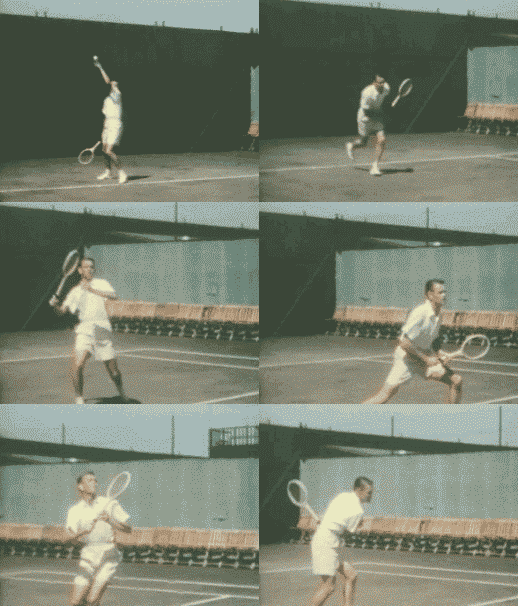
In the heyday of grass court tennis, players like Jack Kramer took
the serve and volley style to a level that has never been equaled.
|
For several decades the world’s greatest men’s
tennis players were, in effect, the world’s greatest grass court
players. This is due to the fact that three of the Grand Slam
Championships, together with the vast majority of Davis Cup challenge
rounds, were contested on grass courts.
It was during this era the strategy of “serve and
volley” was in it’s heyday, since it is, by far, the most effective
technique for success on grass. Great serve and volley players such as
Jack Kramer, Lew Hoad, and Pancho Gonzales took the art to a level that
has not been equaled, before or since.
As the number of grass court tournaments steadily
diminished, the number of serve and volleyers, unfortunately, followed
suit. Today we are faced with tournament fields populated by a plethora of
baseliners who are forced to hit far more shots than are necessary to win
a single point.
Only at Wimbledon has the serve and volley more than
held it’s own, as evidenced by the record of players such as John
McEnroe, Stefan Edberg, Martina Navratilova, and Pete Sampras.

Lew Hoad demonstrates the correct footwork to play serve and
volley—the first step into the court is with the back foot.
|
The success of these same players at the U.S. Open is
evidence that the tactic can still be extremely valuable on other
surfaces, despite the general dominance of baseline tennis in the modern
game. Still, even these modern serve and volley champions are lacking when
compared to the great players of the past, for reasons we are about to
explain.
The Roll of the Serve
In tennis, the server has an enormous advantage over
his opponent, since the server can select the precise placement of the
ball, employing the only shot in tennis where the striker has total
control. This advantage is the basis upon which the success of the serve
and volley game is built.
The toss is critical to developing the serve and
volley. It should be well into the court so the server has to reach out
for it, and his body lean can start the forward momentum necessary to get
to the net as quickly as possible.
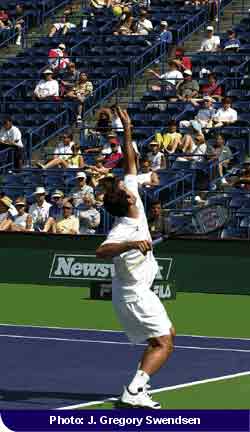
Modern serve and volley players such
as Sampras make a critical error by tossing almost directly above their
heads.
|
In this respect, all serve and volleyers in the
modern game commit a critical error.
Instead of tossing the ball into the court, they toss
the ball almost directly above their heads. They then make a small
vertical leap and land on their forward foot.
Now they must gather themselves, regain their
balance, and sprint to the net. Compare this to the rapid transition to the net made
by Lew Hoad or Kramer.
This critical lost time due to poor footwork means
the server often hits his first volley from well behind the service line. From the tactical point of view, this is unacceptable.
It is common
to see Pete Sampras split step halfway between the baseline and the
service line.
These two interrelated flaws, poor footwork on the
serve leading to poor position on the first volley, do much to explain the
lack of serve and volley success in the pro game.
Correct Footwork
The correct method is for the server to take his
first step into the court with the right foot (right handed server). This takes the server
further into the court faster. There is no lost momentum, and a
natural rhythm to proceed to the net is achieved.
With this
technique the server will hit his first volley from a distance far closer
to the net. A player such as Jack Kramer rarely if ever hit a
first volley from further back in the court than the service line.
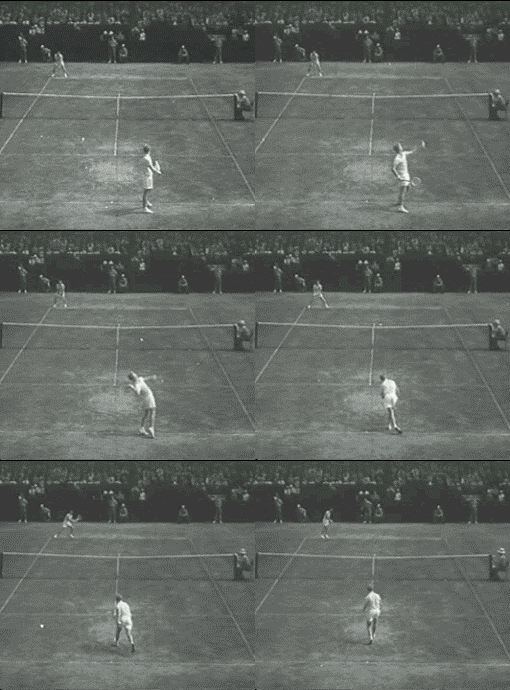
The serve: the only shot where a player has
total control.
|
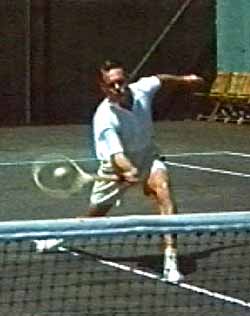
Jack Kramer hits his first volley
from well inside the service line.
|
 The
Kings of the Court historical video, produced by TennisONE
contributing editor, Ed Atkinson, is the ultimate legacy for the tennis
enthusiast, and a must for anyone who wants to understand the
history of the game. The
Kings of the Court historical video, produced by TennisONE
contributing editor, Ed Atkinson, is the ultimate legacy for the tennis
enthusiast, and a must for anyone who wants to understand the
history of the game.
Kings of the court presents amazing, rare,
and often, never before seen footage of the greatest champions
in the history, from Little Bill Johnson and Big Bill Tilden
to Don Budge, Jack Kramer, Lew Hoad, Pancho Gonzales, and Rod
Laver. Narrated by John Forsythe with a highly evocative original
musical score, it can be purchased in the TennisONE ProShop
Click
here to purchase! |
For more articles in Ed Atkinson's Golden Oldies series, visit the TennisONE
lesson library.
Your comments are welcome. Let us know what you about think Ed
Atkinson's article by emailing
us here at TennisONE.
|